How to Choose a Countertop Microwave
To choose a microwave, match its capacity, power and controls to the food you make most often. Measure your counter and dishes first, then decide which cooking features will earn their space.
On this page (10 sections)
- How to choose a microwave for your home
- What size microwave should you choose?
- How many watts should a microwave have?
- Which microwave features are worth choosing?
- How do you check whether a microwave fits your counter?
- Which microwave suits each cooking routine?
- What should you check before buying a microwave?
- How should you set up and care for a countertop microwave?
- What common microwave buying mistakes should you avoid?
- Which countertop microwave should you choose?
To choose a microwave, match capacity, power and controls to the food you make most often. Measure the counter and the largest dishes you use, then compare the features that will make routine cooking easier.
A microwave can be powerful and still be the wrong fit if it crowds the counter or cannot hold your dinner plate. A compact model can also be a poor choice if you regularly heat large bowls or family portions.
Start with our countertop microwave picks for a look at the broader range, then use this guide to settle on the size, power and functions that suit your kitchen.
How to choose a microwave for your home
To choose a microwave, start with the space available, your usual dishes and the jobs you expect it to do. These priorities narrow the field more quickly than comparing every button or feature.
Measure the counter area, including the height beneath cabinets. Check the microwave’s exterior dimensions and the ventilation clearances in its manual before setting a shortlist.
Next, identify the largest plate, bowl or casserole you use regularly. Compare its diameter with the turntable and consider the interior shape, since cubic-foot capacity alone does not say whether a particular dish can rotate freely.
Finally, sort your routine into basic reheating, cooking and defrosting, or specialty tasks such as air frying and baking. The more functions a model adds, the more you should confirm that its cavity and accessories suit the food you actually make.
What size microwave should you choose?
Choose a microwave that fits your regular dishes and leaves enough counter space for safe use. Capacity gives you a general sense of interior volume, while the turntable diameter and cavity dimensions help you assess whether your plates and bowls fit.
| Your usual need | What to compare |
|---|---|
| Mugs, snacks and small plates | Exterior size and turntable diameter |
| Dinner plates and leftovers | Cavity width, capacity and turntable size |
| Large bowls or family portions | Larger capacity and room for the dish |
| Casseroles or serving trays | Interior width, depth and turning clearance |
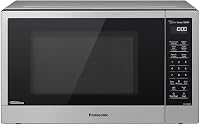
The Panasonic NN-SN67KS has 1.2 cu ft capacity and a 13.4 in turntable. The BLACK+DECKER 1.1 cu ft model has a 12.4 in glass turntable, making those two turntables useful comparison points for everyday dishes.
The Sharp SMC2266KS has 2.2 cu ft capacity and a 16.5 in turntable. Its exterior measures 24.4 in wide, 19.6 in deep and 13.6 in high, so it suits a kitchen with room for a large countertop appliance.
Measure your own plate or bowl and check that it can turn without hitting the sides. For more guidance, see what size microwave do I need? and what size microwave fits a dinner plate?.
How many watts should a microwave have?
Choose wattage based on how much food you heat and how quickly you want it ready. Higher output can shorten cooking time, but it does not solve a poor dish fit or replace following food instructions.
The four models here range from 900 to 1200 watts. The BLACK+DECKER 5-in-1 combo has 900 watts of microwave output, the standard BLACK+DECKER has 1000 watts, and the Panasonic and Sharp models each have 1200 watts.
If you switch between microwaves with different output, use the package directions as a starting point and check food before serving. Larger portions and dense foods may need more time than a mug or small plate.
A 1000 watt model is a practical middle option for many everyday tasks. For a closer comparison, read how many watts a microwave uses and whether 700 watts is good for a microwave.
Which microwave features are worth choosing?
Choose features that remove a step from the jobs you do often. Sensor cooking, express start, presets and combo modes serve different needs, so a short list of useful functions is more helpful than a long feature count.
How to choose a microwave with sensor cooking
Sensor cooking can adjust time and power for selected foods, which helps when you regularly use automatic programs. The Panasonic NN-SN67KS has 16 sensor cook settings and sensor reheat; the Sharp SMC2266KS includes sensor cook and melt or soften functions.
If you often reheat leftovers or rely on presets, sensor controls may be useful. If you prefer to enter the time and power yourself, a simpler control panel may be easier to use.
Read more about what sensor cooking does on a microwave.
Do inverter microwaves matter?
Inverter cooking is a useful feature to compare if you want a steady stream of power at lower settings. Panasonic describes the NN-SN67KS inverter system as delivering continuous cooking power, and the model also has turbo defrost.
That combination makes the Panasonic a strong fit for buyers who value sensor reheating and defrost features in a moderate-size microwave. If those functions are not part of your routine, a standard model with clear controls may be enough.
See our guide to inverter microwaves for more options.
Should you choose an air fryer microwave combo?
Choose an air fryer microwave combo if you want microwave cooking and other cooking modes in one appliance. The BLACK+DECKER 5-in-1 offers microwave, air fry, combi grill/convection, bake and roast functions.
Its 0.9 cu ft capacity and 900 watt microwave output make it a smaller alternative to the full-size models here. Consider how often you will use the added modes, and check that you have room to handle the included bake tray and grill racks.
If you mainly reheat food and rarely use air frying or baking, a standard microwave is the simpler fit. Compare more options in our guide to countertop microwave air fryer combos.
How do you check whether a microwave fits your counter?
Check exterior dimensions, clearance and access to the door before you choose a countertop microwave. Capacity describes interior volume, not the counter space the appliance takes up.
Measure the counter width and depth, and note the height of cabinets above it. Keep the power outlet reachable and follow the ventilation guidance in the manual.
Check the direction and space needed for the door to open. Leave a clear landing spot where you can place a hot dish without reaching over another appliance.
Think about how you will lift food out, especially if the microwave sits high or near a wall. If your counter is tight, compare the models in our compact microwave guide.
Which microwave suits each cooking routine?
The right model depends on your dish sizes, desired controls and most common cooking tasks. These four options have distinct strengths, so you can choose by need instead of treating them as interchangeable.
Panasonic NN-SN67KS: sensor controls and inverter cooking
The Panasonic NN-SN67KS suits buyers who want a medium-size microwave with sensor programs and inverter cooking. It has 1200 watts, 11 power levels and a turntable for everyday plates and bowls.
Its 16 sensor cook settings, turbo defrost and three-level popcorn button provide shortcuts for common tasks. The touch controls have an LED display, and the interior is described as easy to clean.
Choose it if you will use the sensor settings or want the inverter feature in a 1.2 cu ft model. Skip it if you need room for oversized serving dishes or prefer a basic microwave with fewer automatic options.
Compare it with other inverter microwave choices.
Sharp SMC2266KS: large dishes and portions
The Sharp SMC2266KS suits households that regularly heat large dishes or family portions. Its 2.2 cu ft capacity and 16.5 in turntable offer more room than the other models in this guide.
Sensor cook, auto cook, weight and time defrost, 10 power levels and two-stage cooking cover a range of tasks. The sizable exterior needs a generous counter, so measure carefully before choosing it.
Choose it if the larger cavity will solve a regular dish-fit problem and you have counter space to spare. Skip it if your usual food fits a smaller microwave or the exterior dimensions crowd your work area.
See more large countertop microwaves.
BLACK+DECKER 1.1 cu ft 1000 watt: everyday presets
The BLACK+DECKER 1.1 cu ft model suits buyers who want a straightforward 1000 watt microwave with familiar preset buttons. It has 10 power settings and a removable glass turntable.
The presets cover popcorn, potatoes, pizza, frozen vegetables, beverages and dinner plates. A digital display shows the clock and timer, while the push-button door release provides a simple way to open it.
Choose it if those presets match your routine and the 1.1 cu ft capacity fits your regular dishes. Skip it if you want sensor cooking or additional cooking modes.
For a wider comparison of this power level, see the best 1000 watt microwaves.
BLACK+DECKER 5-in-1: extra cooking modes in one appliance
The BLACK+DECKER 5-in-1 suits buyers who want air frying, baking and roasting along with microwave cooking. It combines those modes in a 0.9 cu ft countertop appliance.
The microwave output is 900 watts, with 10 cooking levels and 7 automatic menus. It also has 11 air fry presets for foods such as fries, chicken pieces and vegetables, plus a child-lock setting.
Choose it if you expect to use its added cooking modes and your usual dishes fit the smaller cavity. Skip it if you need a large turntable or want a simple, higher-output microwave.
If you're weighing a combo against a separate appliance, read microwave vs air fryer.
What should you check before buying a microwave?
Before buying, compare the counter fit, dish fit, wattage and features in that order. This keeps the decision focused on daily use rather than a feature you may rarely touch.
- Measure the counter space and check the microwave’s exterior dimensions.
- Compare your largest regular dish with the turntable and interior.
- Match capacity to your usual portions, not an occasional oversized casserole.
- Choose wattage that suits your cooking pace and food portions.
- Decide whether you will use sensor controls, presets or combo modes.
- Check the door opening, interior cleanup and included accessories.
- Read the manual for ventilation, electrical and safe-use instructions.
Do not assume a microwave’s capacity tells you its exterior size, or that a large model will suit every dish. Check both measurements and the shape of your most-used cookware.
For broader brand context, see what the best microwave brand is. A brand can help you create a shortlist, while the model’s dimensions and controls determine whether it fits your kitchen.
How should you set up and care for a countertop microwave?
Set up a countertop microwave on a stable, level surface with the clearances required by its manual. Good placement leaves room for ventilation, a reachable outlet and safe access to hot food.
Before moving the appliance into place, confirm that the counter can support it and that the door can open fully. Keep vents clear, use the correct outlet as directed in the manual, and avoid placing items on the microwave unless the instructions allow it.
Install the turntable and its support as directed before cooking. Place food in microwave-safe cookware, center the dish on the turntable and use a cover that allows steam to escape.
Clean spills promptly after the interior cools. Wipe the interior and turntable with a soft damp cloth, and avoid abrasive cleaners that can damage surfaces.
Remove the glass turntable for cleaning if the manual permits, then dry and reinstall it securely.
What common microwave buying mistakes should you avoid?
The most common mistake is choosing by capacity or wattage alone. A microwave still needs to fit the counter, accommodate your dishes and provide controls you want to use.
- Ignoring exterior dimensions: A large cavity can require more counter width and depth than expected.
- Assuming capacity guarantees dish fit: Compare the turntable diameter and your actual plate or bowl.
- Buying more power than you need: Higher output can be useful, but clear controls and a suitable cavity matter too.
- Paying for modes you will rarely use: An air fryer combo only makes sense if you will use those extra functions.
- Overlooking included accessories: Check what trays and racks come with a combo and where you will store them.
- Blocking ventilation: Follow the clearance instructions instead of pushing the microwave tightly against a wall or cabinet.
- Using the wrong cookware: Use microwave-safe dishes and follow the food and appliance instructions.
- Leaving food unattended: Stir or rotate when directions call for it, and check that food is heated through before serving.
Which countertop microwave should you choose?
Choose the Panasonic if sensor programs and inverter cooking are priorities, the Sharp if you regularly need a large cavity, the BLACK+DECKER 1.1 cu ft model for familiar presets and 1000 watt output, or the 5-in-1 combo if you will use its air fry, bake and roast modes.
Your decision should start with your counter and dishes, then account for power and controls. For more models after narrowing those needs, return to our countertop microwave picks.
Frequently asked questions
How do I choose a microwave for home?
Choose a home microwave by measuring its counter space, checking that your usual dishes fit, and matching its controls and power to your routine. A mug and a small plate need less room than a casserole or family serving dish.
Compare the microwave’s outside dimensions and turntable diameter before you decide.
What should I look for when buying a microwave?
Look for a microwave that fits your counter and your dishes, then compare wattage, controls and features you’ll use. Sensor cooking and presets can simplify routine meals, while a turntable helps you move food during cooking.
If you want air frying or baking, check the combo’s capacity and included accessories.
Is a 1000 watt microwave powerful enough?
A 1000 watt microwave can handle many everyday reheating and cooking tasks. Actual time depends on the food, portion and directions, so follow package instructions and check the food as it cooks.
If you regularly heat larger portions or want higher output, compare 1200 watt models and their capacity.
How much counter space does a countertop microwave need?
Measure the space for the microwave’s width, depth and height, then check its manual for required clearance. Leave room for the door to open and for you to lift hot dishes out safely.
Also keep the power outlet reachable and avoid assuming that a larger capacity means a particular outside size.