How Many Watts Does a Microwave Use?
A countertop microwave typically has about 700 to 1,200 watts of cooking power. Choose a lower-wattage compact model for light reheating and a higher-wattage model for larger portions or more frequent use.
On this page (7 sections)
- How many watts does a microwave use for everyday cooking?
- What wattage should you choose for your routine?
- When is 1,000 watts a good middle ground?
- When should you choose 1,200 watts?
- What is the difference between cooking watts and input watts?
- How should you set up and use a microwave?
- Which microwave wattage is right for you?
A countertop microwave typically uses 700 to 1,200 watts of cooking power. If you’re asking how many watts does a microwave use because you’re shopping, match the wattage to your portion sizes, counter space, and how often you cook.
Cooking watts describe output for heating food. They aren’t always the same as the electrical input the appliance draws, so check both numbers when planning its power requirements.
How many watts does a microwave use for everyday cooking?
Many countertop choices fall between about 700 and 1,200 watts of cooking power. A 700-watt model can suit simple reheating and smaller portions, while 1,000 watts is a useful middle ground for daily use.
A 1,200-watt model gives more output and may suit frequent cooking or larger portions.
Wattage is only one part of the decision. Capacity tells you how much room is inside, and the outside dimensions tell you whether the microwave fits your counter.
For a broader set of buying factors, see our guide to choosing a countertop microwave. If interior space is the main concern, use our guide to what size microwave you need.
What wattage should you choose for your routine?
Choose the lowest wattage and capacity that comfortably handle your usual food and dishes. A smaller microwave can save counter space, while a larger unit with more output can be more convenient when you heat substantial portions or use it throughout the day.
The Frigidaire has 700 watts and 0.7 cubic feet of capacity. It includes 10 power levels, six one-touch menus, auto defrost, express cooking, and a removable glass turntable.
This model suits a student, office worker, or one-person household that mostly warms drinks, snacks, and modest portions. Skip it if you often heat family-sized servings or need room for broad dinner plates and larger containers.
Before buying, measure the counter depth and width, then leave the clearances required by the manual. Check that your most-used dish fits on the turntable without touching the walls.
When is 1,000 watts a good middle ground?
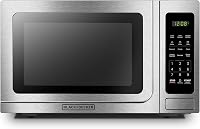
A 1,000-watt microwave is a balanced choice for regular reheating and cooking without moving to the highest output in this group. The BLACK+DECKER combines 1,000 watts of output with 1.1 cubic feet of capacity and 10 power settings.
Its six preprogrammed buttons cover foods such as popcorn, potatoes, pizza, frozen vegetables, beverages, and dinner plates. It also has a digital display, kitchen timer, child safety lock, interior light, removable turntable, and push-button door release.
This model suits households that reheat meals often and want more room than a compact microwave offers. Skip it if counter space is tight or most of your use is limited to small snacks and drinks.
The unit measures 20.6 inches long, 14.8 inches deep, and 11.8 inches high. Compare those dimensions with your counter and cabinet space, and follow the manual’s installation clearances.
For a direct look at the difference in cooking power, read our guide to 700-watt vs. 1,000-watt microwaves.
You can also compare models in our guide to 1,000-watt microwaves.
When should you choose 1,200 watts?
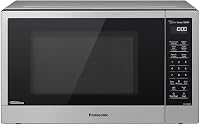
Choose 1,200 watts if you cook often and want more output plus automatic cooking help. The Panasonic NN-SN65KB has 1.2 cubic feet of capacity, inverter technology, and Genius Sensor cook and reheat functions.
It has 11 power levels, 10 sensor cook settings, 15 auto cook options, Turbo Defrost, and a 13.4-inch turntable. Panasonic describes its inverter technology as providing a continuous stream of cooking power, and its Genius Sensor adjusts cooking time and power automatically.
This model suits someone who wants sensor cooking and uses a microwave for more than quick snacks. Skip it if you rarely use automatic features or would rather keep the controls simple.
Measure its 20.7-inch width, 15.8-inch depth, and 12.2-inch height against your counter. For more options with this feature, see the best inverter microwaves.
What is the difference between cooking watts and input watts?
Cooking watts measure output for heating food, while input watts measure power drawn by the appliance. The BLACK+DECKER model has 1,000 watts of output and 1,600 watts of input.
That difference matters when you’re checking whether an outlet and circuit meet the appliance’s requirements. Read the microwave’s label and manual, and follow their electrical guidance rather than estimating from cooking wattage.
For safe placement and use, review the FDA’s microwave oven safety guidance.
How should you set up and use a microwave?
Set the microwave on a stable, level counter with the clearances specified in its manual. Leave ventilation space around it, keep it away from heat and moisture, and plug it in according to the manufacturer’s instructions.
Use microwave-safe dishes and avoid metal unless the manual specifically allows it. Center food on the turntable, cover it when appropriate, and stir or rotate it partway through heating if the food needs more even warmth.
A common mistake is to copy a cooking time without accounting for a microwave’s wattage. Follow package directions as a starting point, then check the food and add time in short bursts; lower-wattage models may need longer.
Another mistake is choosing by wattage alone. A powerful unit still needs enough interior room for your dishes, while a compact model may not suit a large plate even if its controls meet your needs.
Clean spills promptly after the interior cools, using a soft cloth and mild cleaning solution. Remove and wash the glass turntable as directed, and avoid harsh tools that can scratch surfaces.
Which microwave wattage is right for you?
Pick 700 watts for small portions and limited counter space, 1,000 watts for a flexible everyday choice, or 1,200 watts for frequent cooking and sensor features. If you’re still deciding how many watts does a microwave use for your home, let your regular dishes and meal sizes guide the choice.
The Frigidaire is the compact pick for snacks, drinks, and modest portions. Choose the BLACK+DECKER for a larger everyday cavity, or the Panasonic if higher output and sensor functions matter to you.
If you’re unsure whether 700 watts will cover your routine, read is 700 watts good for a microwave?. For a final side-by-side wattage comparison, see [700-watt vs.
1,000-watt microwaves](/700-watt-microwave-vs-1000-watt-microwave/).
Frequently asked questions
How many watts does a small microwave use?
A small countertop microwave may have about 700 watts of cooking power. The Frigidaire model here combines 700 watts with 0.7 cubic feet of capacity, making it a fit for small kitchens, dorm rooms, or offices.
Check both capacity and wattage: a compact interior may not fit the dishes or portions you use most.
Is 1,000 watts enough for a microwave?
Yes, 1,000 watts is a useful level for many everyday reheating and cooking tasks. The BLACK+DECKER model pairs that output with 1.1 cubic feet of capacity and 10 power settings.
Measure your counter and consider your usual dish sizes before choosing.
Do microwave watts mean electricity use?
Cooking watts describe the microwave’s output for heating food. Electrical input can be higher: the BLACK+DECKER model has 1,000 watts of output and 1,600 watts of input power.
Use the appliance label or manual to check electrical requirements for your kitchen.
Does higher microwave wattage cook food faster?
Higher cooking wattage can heat a similar portion faster when other conditions are alike. Food type, starting temperature, container, portion size, and chosen power level all affect the time.
Follow package directions, then check the food and add time in short increments if needed.