700 Watt vs 1000 Watt Microwave: Which Is Better? (October 2026)
Choose 700 watts for a compact microwave and smaller portions; choose 1000 watts for more cooking power and a larger cavity. In a 700 watt microwave vs 1000 watt microwave comparison, your counter space and usual dish size help settle the choice.
On this page (9 sections)
- 700 watt microwave vs 1000 watt microwave: what changes?
- Which microwave fits your counter and dishes?
- Which microwave suits your cooking habits?
- What setup and care help avoid common problems?
- What does input power tell you?
- Who should buy each microwave?
- Which one should you choose?
- See the three microwaves
- How we compared 700 watt and 1000 watt microwaves
Choose 700 watts for a compact microwave and smaller portions; choose 1000 watts for more cooking power and a larger cavity. This 700 watt microwave vs 1000 watt microwave comparison covers heating pace, counter fit and the size of dishes each option can handle.
The Frigidaire and Farberware pair 700 watts with compact 0.7 cu ft cavities. The BLACK+DECKER offers 1000 watts and a roomier 1.1 cu ft interior.
Think about what you heat most often. A larger cavity can accommodate more dish sizes, while a compact model can be easier to fit in a small kitchen, dorm room or office.

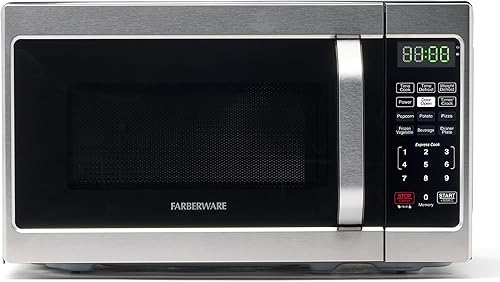 Best for flexible defrosting
Farberware 0.7 Cu Ft Microwave, Stainless
700 watt microwave vs 1000 watt microwave: what changes?
A 1000 watt microwave has about 43% more cooking power than a 700 watt model. That can shorten heating time for the same food and portion, though the exact time depends on the food and appliance.
All three models have 10 power levels or settings, so you can adjust cooking power for different tasks. Their cavities differ: the two 700 watt options hold 0.7 cu ft, and the 1000 watt BLACK+DECKER holds 1.1 cu ft.
Wattage alone doesn't determine whether a microwave will fit your routine. Compare the cavity and the dishes you use, along with how much counter space you can spare.
Does 1000 watts heat food 43% faster?
No fixed time difference is guaranteed by the wattage gap. Portion size, shape, starting temperature and heat distribution all affect how long food takes.
Use package directions as your starting point. Add time in short intervals if needed, and stir or rotate when the directions recommend it.
For more detail on the lower-power option, read whether 700 watts is good for a microwave. The best answer depends on your usual meals and how much time you have.
Which microwave fits your counter and dishes?
The 0.7 cu ft models take up less counter space, while the 1.1 cu ft BLACK+DECKER offers more interior capacity. Measure the available spot and your common dishes before choosing by wattage alone.
The Frigidaire measures 17.8 x 12.3 x 10.2 inches in width, depth and height. The Farberware measures 17.3 x 12.99 x 10.14 inches, and the BLACK+DECKER measures 20.6 x 14.8 x 11.8 inches.
Before setup, check the manual for required clearance and ventilation. Leave room to open the door, reach the controls and remove hot dishes safely.
Measure a plate, bowl or container you use often, including its handles if it has them. If it needs more room than the compact cavity allows, browse our guide to 1000 watt microwaves for larger-capacity choices.
Is 0.7 cu ft enough for your meals?
A 0.7 cu ft microwave suits drinks, snacks and small portions if your dishes fit inside. Both compact models include a glass turntable, which can be removed for cleaning.
That size can work well in a dorm room, office or small kitchen. It may not suit you if you often heat wide plates, large bowls or several portions at once.
The Frigidaire has six preprogrammed settings, auto defrost and express cooking. The Farberware offers six one-touch options, defrost by weight or time, and multi-stage cooking.
The Farberware and Frigidaire have similar capacity, but their control features differ. Choose based on the tasks you repeat and whether the stated options match how you cook.
Which microwave suits your cooking habits?
Choose 700 watts for routine reheating when a smaller cavity fits your meals; choose 1000 watts when you want more cooking power and room for larger dishes. Use the food directions to set a safe heating time.
The BLACK+DECKER has six preprogrammed buttons for popcorn, potato, pizza, frozen vegetables, beverages and dinner plates. Its other controls include a clock, kitchen timer, 30-second express cooking and child safety lock.
The Frigidaire has a digital timer and clock, one-touch menus, auto defrost and express cooking. Farberware adds defrost by weight or time and multi-stage cooking alongside its one-touch options.
Preset buttons are convenient when they match what you heat most. For less common foods, adjustable power levels and the cooking directions give you more control.
What setup and care help avoid common problems?
Measure first, use microwave-safe dishes, and keep the interior clean to make everyday use easier. Follow the manual for setup, operation and cleaning instructions for your specific model.
Set the microwave on a stable, level counter with the clearances the manual calls for. Don't place it where the door is blocked or where you can't safely reach the controls.
Use cookware labeled microwave-safe, and avoid putting metal objects inside unless the manual explicitly allows them. Cover food when the directions call for it, but leave space for steam to escape.
Wipe spills after the interior cools, and clean a removable turntable separately according to the manual. Refit the turntable correctly before cooking so it can rotate as intended.
A common mistake is choosing a compact model based only on its outside dimensions, then finding that a regular plate doesn't fit. Another is entering a 1000 watt recipe time into a 700 watt microwave without checking progress or adjusting the time.
What about cooking evenly?
More wattage doesn't guarantee more even heating. Food shape, placement and stirring affect how heat spreads, so follow the directions and allow standing time when they call for it.
All three microwaves have glass turntables. Stirring or rotating food manually can still help when the instructions recommend it.
If cold spots are a recurring problem, read why microwaves heat unevenly. It explains common causes and practical steps that may help.
What does input power tell you?
The BLACK+DECKER uses 1600 watts of input power and has 1000 watts of output cooking power. Input power is the electricity drawn by the appliance; output power is the cooking-power rating used in this comparison.
Don't compare one microwave's input figure with another microwave's output figure. Check that you're comparing the same kind of power measurement in a model's electrical information.
For a broader explanation, read how many watts a microwave uses. It covers the difference between cooking power and electricity use.
Who should buy each microwave?
Choose a compact 700 watt model if counter space and smaller portions matter most; choose the 1000 watt model if you want more cooking power and a larger cavity. Each is a poor fit if its dimensions or capacity don't suit your kitchen.
The Frigidaire is a sensible fit for a small kitchen, dorm room or office where 0.7 cu ft is enough. Its auto defrost and express cooking are useful if you want quick controls for common tasks.
Choose the Farberware if you want a compact microwave with defrost by weight or time and multi-stage cooking. Skip both compact options if the dishes you use most won't fit comfortably.
The BLACK+DECKER suits households that often heat larger portions or want the additional cavity space. Skip it if your counter cannot fit its larger dimensions with the clearances specified in its manual.
Which one should you choose?
For the 700 watt microwave vs 1000 watt microwave decision, choose 700 watts for compact counters and smaller portions, or 1000 watts for more cooking power and interior room. Start with a measurement of your available space, then check that your everyday dishes fit.
Choose the Frigidaire for a compact setup with one-touch menus, auto defrost and express cooking. Choose the Farberware if defrost by weight or time and multi-stage cooking matter more to you.
Choose the BLACK+DECKER for its 1000 watt output and 1.1 cu ft cavity, provided its dimensions fit your counter. For more help comparing controls and power features, visit the power and features guide.
See the three microwaves
How we compared 700 watt and 1000 watt microwaves
We compared cooking power, capacity, dimensions and controls to show how each option fits different counters and cooking routines. These factors help distinguish the compact models from the larger one.
The Frigidaire and Farberware each combine 700 watts with a 0.7 cu ft cavity. Their features differ: Frigidaire includes auto defrost and express cooking, while Farberware specifies defrost by weight or time and multi-stage cooking.
The BLACK+DECKER has 1000 watts and a 1.1 cu ft cavity, plus six preset buttons and a 12.4 inch glass turntable. Its larger dimensions make counter fit an important part of the decision.
A higher wattage can help when faster heating matters, but the right choice still depends on your kitchen and portion sizes. Measure the counter, check the manual's setup instructions, and match the cavity to your usual dishes.
Frequently asked questions
Is a 1000 watt microwave much faster than a 700 watt microwave?
A 1000 watt microwave delivers more cooking power, so it may heat the same food in less time. The exact difference depends on the food, portion size, starting temperature and microwave design.
Follow the cooking directions, stir or rotate when advised, and check that food is heated through.
Is 700 watts enough for everyday microwave use?
Yes, 700 watts can suit everyday reheating, drinks and smaller portions if you can allow for longer heating times. Compact models such as the Frigidaire and Farberware here also have 0.7 cu ft of capacity.
Check your usual dish size before choosing a small cavity.
What is the main difference between a 700 watt and 1000 watt microwave?
The main difference is cooking power: 1000 watts is about 43% higher than 700 watts. The models compared here also differ in capacity, with 0.7 cu ft for the 700 watt options and 1.1 cu ft for the BLACK+DECKER.
Do higher wattage microwaves use more electricity?
A 1000 watt microwave has a higher cooking-power rating than a 700 watt microwave, but that alone doesn't show total electricity use for a meal or over time. Cooking duration and the unit's input power matter too.
Compare the exact models' energy information if electricity use is a deciding factor.
Should I buy a 700 watt or 1000 watt microwave?
Choose 700 watts if a compact 0.7 cu ft microwave suits your counter and portions. Choose 1000 watts if you want more cooking power and the larger 1.1 cu ft cavity in the BLACK+DECKER.
Measure your counter and check your usual dishes before deciding.


