Do Inverter Microwaves Have Turntables?
Some inverter microwaves have turntables and some don't. Inverter technology controls power delivery, while the turntable is a separate design choice, so you'll find both spinning-plate and flatbed inverter models on the shelf.
On this page (8 sections)
- What does "inverter" actually mean on a microwave?
- Why do so many inverter microwaves still use a turntable?
- How do flatbed inverter microwaves heat food without spinning it?
- Which design heats more evenly, flatbed or turntable?
- What are the practical differences in daily use?
- Do flatbed inverter microwaves lose any features?
- How do you choose between the two designs?
- Which one should you buy?
Some inverter microwaves have turntables and some don't. Inverter technology controls how power is delivered, while the turntable is a separate design choice, so you'll find both spinning-plate and flatbed inverter models.
That matters because shoppers mix the two features together. An inverter label tells you the microwave varies its power smoothly instead of pulsing on and off.
It says nothing about whether there's a glass plate spinning on a roller ring inside.
What does "inverter" actually mean on a microwave?
Inverter means the microwave delivers steady, adjustable power instead of switching the magnetron on and off. Panasonic made the technology famous and still uses it across its countertop line.
A standard microwave runs at full power and cycles the magnetron to fake lower settings. An inverter model dials the power down continuously, so defrosting and simmering are gentler.
Panasonic says its inverter technology "generates a continuous stream of microwave cooking power for evenly heated foods edges to center."
The inverter sits in the power supply, not the cavity floor. That's why the same inverter circuit appears in both turntable and flatbed bodies.
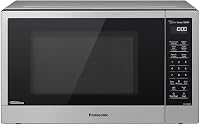
The Panasonic NN-SN67KS pairs an inverter with a 13.4-inch glass turntable. The Panasonic 1.0 cu ft flatbed pairs an inverter with a hidden turntable and a flat floor.
Why do so many inverter microwaves still use a turntable?
A turntable moves food through the microwave field, which helps even heating on models that don't spread the field another way. It's a proven, low-cost way to reduce hot and cold spots.
Microwaves don't fill the cavity evenly. Waves bounce off the walls and form patterns of high and low energy.
Spinning the plate carries each part of the dish through the hot zones, so a plate of leftovers warms more uniformly.
The Panasonic NN-SN67KS uses this approach: a 13.4-inch turntable sits on a roller ring and turns during cooking. Turntables also make the interior simpler to engineer, which keeps prices reasonable.
Our comparison of flatbed vs turntable microwave designs covers the trade-offs in more depth.
How do flatbed inverter microwaves heat food without spinning it?
Flatbed models spread the microwaves with a hidden antenna or stirrer instead of rotating the food. The floor stays still while the energy pattern moves.
A flatbed cavity typically hides a slot antenna beneath the base or uses a rotating stirrer fan to scatter the waves. Panasonic's flatbed design puts a hidden turntable under the floor, so the power source moves while the surface stays flat.
Sharp describes its flatbed as a "space-saving flatbed interior" that "maximiz[es] usable cooking space."
The result is a flat, clear floor you can set a square casserole or a wide plate on. Nothing tips or catches on a roller ring.
If you want the background first, our explainer on what is a flatbed microwave walks through the design.
Which design heats more evenly, flatbed or turntable?
Both can heat evenly when the inverter and the field-spreading design are done well, but the turntable has the longer track record. Evenness depends on the whole system, not just the plate.
A turntable plus an inverter is a well-tested combination. The plate rotation handles the field pattern, and the inverter smooths the power.
Flatbed models lean entirely on the antenna or stirrer, so the engineering matters more.
In practice, the gap is smaller than marketing suggests. A flatbed inverter with a good stirrer can warm a plate of leftovers without a cold center.
A turntable model is the safer bet if even heating is your top priority and you don't mind the moving parts.
Who should pick the Panasonic NN-SN67KS?
Pick the Panasonic NN-SN67KS if you want a proven inverter plus a large turntable and you reheat plates and bowls more than square dishes. Its 1.2 cu ft cavity and 1200 watts suit family kitchens.
The 13.4-inch glass plate takes most dinner plates and a standard popcorn bowl. Panasonic's Genius Sensor adjusts power and time by reading steam, which helps with leftovers and vegetables.
Turbo Defrost speeds up thawing frozen meat.
The trade-off is the moving parts. You'll lift out the glass plate and roller ring to clean under them, and a wide rectangular dish may not fit the round plate.
That's the price of the spinning design. For more options with this power supply, see our roundup of the best inverter microwaves.
What are the practical differences in daily use?
Flatbed models give you more usable floor area and fewer parts to wash, while turntables handle round plates and bowls well. The right pick depends on what you cook most.
With a turntable, round dishes sit centered and spin cleanly. Rectangular containers can hit the walls or stop the plate, so you size dishes to the plate's diameter.
Cleaning means removing the glass plate and wiping the roller ring and track.
A flatbed floor holds square and oval dishes without a size ceiling beyond the cavity. There's no plate to lift, so a quick wipe covers the whole base.
The Panasonic flatbed still uses a hidden turntable, so the even-heating benefit stays, but the visible floor doesn't move.
Do flatbed inverter microwaves lose any features?
No, a flatbed inverter microwave still offers the inverter benefits and most cooking programs. The difference is the cavity floor, not the power supply or the sensor cooking.
The Sharp SMC1174KS shows the pattern: 1100 watts, inverter technology, Express Cook up to 6 minutes, a +30 key and preset buttons. It fits plates up to 13.25 by 13 inches on the flat floor.
The Panasonic 1.0 cu ft flatbed adds Genius Sensor 2.0 one-touch cooking and a pull-down door.
You still get defrost, reheat and auto cook settings. What you give up is the familiar spinning plate and, on some models, the round-plate sizing.
If you're weighing this against another heating feature, our guide to inverter vs convection microwave explains where each one fits.
Who should pick the Panasonic 1.0 cu ft flatbed?
Choose the Panasonic 1.0 cu ft flatbed if counter space is tight and you want inverter heating without a spinning plate. Its 1.0 cu ft cavity and pull-down door suit small kitchens and apartments.
The flat floor holds square containers and wide plates up to the cavity limits. Genius Sensor 2.0 monitors food temperature and sets power and time, so one-touch reheating is straightforward.
The pull-down door gives more natural access than a side-hinged door in a narrow gap.
The smaller 1.0 cu ft capacity means less room for big casseroles. If you regularly reheat family-sized dishes, the 1.2 cu ft Panasonic turntable model fits more.
Measure your cabinet opening and your largest dish before ordering.
How do you choose between the two designs?
Pick a turntable inverter if you reheat round plates and want the longest-proven even heating. Pick a flatbed inverter if you want usable floor space and easier cleaning.
Both use the same steady power delivery.
Here's the decision rule. If your meals are mostly plated leftovers, soup bowls and popcorn, a turntable model like the NN-SN67KS handles them well.
If you reheat square containers, large oval platters or casserole dishes, a flatbed model gives you more room.
Who should pick the Sharp SMC1174KS?
The Sharp SMC1174KS fits buyers who want a mid-size flatbed with inverter power and a silent mode. Its 1.1 cu ft cavity and 1100 watts work for couples and small families.
The flat floor takes plates up to 13.25 by 13 inches and wipes clean without lifting a glass plate. Express Cook covers one-touch cooking up to 6 minutes, and the +30 key adds time during cooking.
Silent mode helps in open-plan homes and late-night kitchens.
The 1100-watt output is a step below the 1200-watt Panasonic models here. If speed on large portions matters more than a flat floor, the higher-wattage turntable model is the stronger pick.
Otherwise, this is a solid middle choice.
Which one should you buy?
For most people, a turntable inverter is the safe default, and the Panasonic NN-SN67KS is the one we'd pick because it combines 1200 watts, a 13.4-inch turntable and sensor cooking. So do inverter microwaves have turntables?
Many do, and this model shows why the combination still works.
Go flatbed if usable floor space and easy cleaning matter more. The Panasonic 1.0 cu ft flatbed is the compact choice, and the Sharp SMC1174KS is the mid-size one.
Measure your counter and your largest dish, then match the design to the way you actually reheat food.
Frequently asked questions
Do inverter microwaves have turntables?
Not always. Inverter technology and turntables are separate features.
Plenty of inverter microwaves use a glass turntable, while flatbed inverter models heat without one.
The label tells you about the power supply, so check the interior design before you buy.
Is a flatbed inverter microwave better than a turntable one?
Neither is better for everyone. A flatbed gives you more usable floor space and easier cleaning.
A turntable moves food through the microwave field so edges and center heat more evenly on models without a stirrer.
Pick based on the dishes you reheat most.
Why do some inverter microwaves skip the turntable?
Flatbed models use a hidden antenna or stirrer to spread microwaves across the cavity, so the plate doesn't need to spin. That frees the floor for square dishes and large plates.
It also removes the glass plate and roller ring you'd otherwise wash.
Can you put a turntable in a flatbed microwave?
No. A flatbed has no turntable motor or roller ring, and its floor is designed for direct contact with dishes.
Adding a loose plate would block the hidden antenna and could scratch the interior.
Use the flatbed as built.
Does a turntable affect how evenly an inverter microwave heats?
It can help. The turntable carries food through areas of the microwave field, so a plate of leftovers warms more evenly from edge to center.
Flatbed inverter models rely on a stirrer or slot antenna to spread the field instead.
Which inverter microwave is best for tight counter space?
A flatbed model usually wins on usable space for its footprint, because the whole floor holds a dish. The Panasonic 1.0 cu ft flatbed is the most compact of the three picks here.
Measure your cabinet gap and the largest plate you reheat before deciding.